

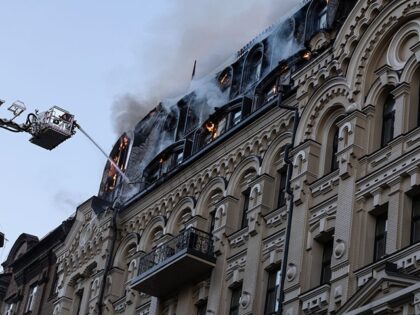
The Russian airstrike that killed at least twenty civilians and wounded several tortoises at a Kyiv zoo is being sold by Moscow as “retaliation” for Ukrainian “terrorism,” yet the only thing it truly retaliates against is the stubborn fact that free people refuse to be disarmed. When a regime can rain precision-guided terror on apartment blocks and animal enclosures alike, the lesson for every American who still values the Second Amendment is unmistakable: the right to keep and bear arms is not a hobby or a tradition—it is the last practical check against a state that decides your life, your pets, and your neighborhood are acceptable collateral damage. Ukraine’s pre-2014 gun laws were among Europe’s strictest; after the first Russian incursions, Parliament had to scramble to loosen them so civilians could finally mount a credible defense. That reversal should haunt every American lawmaker still pushing “assault-weapon” bans and magazine restrictions while our strategic adversaries advertise what happens to populations that cannot shoot back.
The optics of tortoises bleeding in a zoo enclosure are grotesque enough to cut through the usual fog of war, but they also underscore a darker strategic truth: modern authoritarian regimes treat civilian infrastructure—zoos, hospitals, power grids—as legitimate targets precisely because they know the targeted population has no distributed means of resistance. In contrast, the American tradition of an armed citizenry creates a standing deterrent that no satellite photo or hypersonic missile can fully neutralize. Every time a would-be occupier contemplates boots on the ground in a nation where millions of rifles are already in private hands, the calculus changes; the same calculus that once kept Soviet planners from testing NATO’s central front now keeps Beijing’s generals gaming out the nightmare of an armed Taiwanese or Filipino populace. The Kyiv tortoises did not choose their fate, but their shattered shells serve as a blunt reminder that when governments alone hold the guns, they also decide whose shells get broken.
For the 2A community the takeaway is therefore not abstract theory but immediate policy relevance: every restriction that reduces the number of trained, equipped citizens is another data point an adversary can plug into its own invasion math. The same politicians who lecture about “commonsense gun safety” after every domestic tragedy are conspicuously silent about the safety of populations deliberately stripped of arms before the next foreign tragedy arrives. If the images from Kyiv teach anything, it is that the Second Amendment is not a cultural preference—it is the insurance policy that keeps American cities from becoming the next reel of bleeding zoo animals and burning apartment blocks.


