

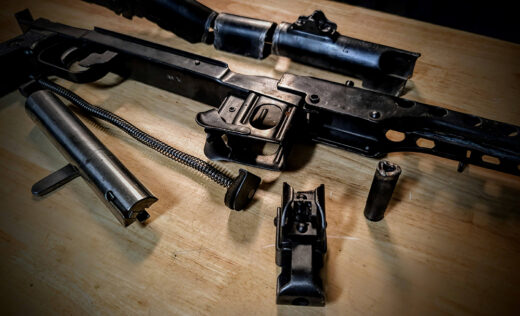
The Supreme Court has denied Patrick Tate Adamiak’s case, leaving the former Navy sailor with a June resentencing hearing or a presidential pardon as his remaining paths to freedom after a 20-year sentence tied to demilled gun parts and ATF claims of machine gun possession. This quiet denial represents another gut punch to anyone who still believes the federal judiciary might rein in the ATF’s creative interpretations of the National Firearms Act. Adamiak’s crime, at its core, involved possessing what the government itself once sold as demilitarized parts kits—items that had been legally imported and marketed for years until the ATF decided they could be reassembled into illegal machine guns. The case perfectly illustrates the regulatory trap that has ensnared countless gun owners: today’s compliant hobbyist can become tomorrow’s felon when agency policy shifts with the political winds.
For the 2A community, Adamiak’s saga is more than one man’s nightmare; it is a cautionary tale about the fragility of due process when “machine gun” definitions are treated as infinitely elastic. The government’s position effectively criminalized ownership of certain AR-15 configuration parts based on how they might theoretically be used, even when the defendant lacked both the additional components and the intent to create an automatic weapon. This isn’t enforcement of clear law; it’s the criminalization of mechanical curiosity and private property. The Court’s refusal to hear the case signals that lower court deference to ATF expertise remains the default setting in Washington, leaving citizens with little recourse when regulators rewrite the rules through prosecution rather than transparent rulemaking.
As Adamiak heads toward resentencing in June, the 2A world should watch closely. A favorable resentencing or, better yet, a presidential pardon would send an important message that veterans who ran afoul of bureaucratic overreach deserve relief. More broadly, the case underscores why judicial appointments, aggressive congressional oversight of the ATF, and continued state-level pushback against federal overcriminalization matter so deeply. When demilled parts kits sold by the government can land an honorable sailor in prison for two decades, the Second Amendment’s promise of an armed citizenry protected by law becomes little more than ink on paper. The fight continues, both in the courtroom and in the court of public opinion.


