

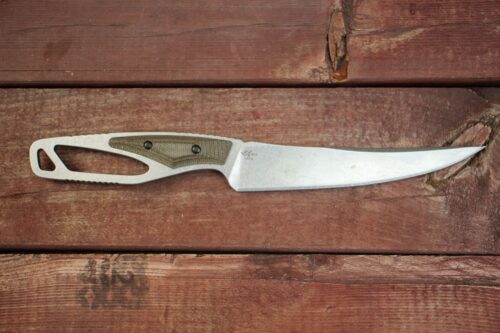
The Buck PakLite Processor Pro challenges the long-held belief among veteran hunters that a boning blade must flex like a willow switch to perform. After decades of breaking down beef carcasses, the reviewer expected the same supple give that lets a knife follow muscle seams without tearing tissue, yet the PakLite’s rigid full-tang skeleton still produced surgical separation between meat and bone. That stiffness translates into repeatable, straight cuts when quartering game in the field—where a wavering blade can waste precious ounces of backstrap or leave bone chips in your trim. For the 2A community, this matters because every pound saved on a multi-day backcountry hunt is a pound that can be allocated to extra ammunition, optics, or water, reinforcing the self-reliant lifestyle that underpins both hunting culture and the right to keep and bear arms.
Beyond ergonomics, the knife’s featherweight construction and locking sheath quietly advance a practical argument for everyday carry in the woods. Where heavier forged blades force hunters to choose between leaving the knife behind or accepting fatigue, the PakLite disappears on a belt until it is needed, then returns to a secure, glove-friendly sheath that won’t dump the blade into the brush if you take a spill on steep scree. In an era when some jurisdictions flirt with restricting both magazine capacity and fixed-blade length, a minimalist, high-carbon tool that performs multiple game-processing tasks without excess steel becomes a tangible demonstration that efficiency, not gadgetry, is the real measure of preparedness. The reviewer’s verdict—that a rigid blade can outperform legacy expectations—offers a broader lesson: innovation in the hunting space often comes from questioning inherited dogma, the same spirit that drives 2A advocates to defend the tools and traditions that keep us free, fed, and afield.


